Back to school: the fight for a natural history GCSE | with Caroline Lucas and Mary Colwell
Date:
Summary
After more than a decade of campaigning, a natural history GCSE for England is finally on the table. In this special episode, former MP Caroline Lucas and conservationist Mary Colwell sit down to unpack the government’s new consultation: what it gets right, what it’s missing and what bumblebees have to do with it.
Transcript
Ruth Chambers: [00:00:00] Welcome to this special edition of the Green Alliance Podcast.
I’m delighted to be joined by two brilliant campaigners, Caroline Lucas and Mary Colwell. Caroline was the Green Party’s first Member of Parliament, representing Brighton Pavilion between 2010 and 2024. She’s Professor of Practice in Environmental Sustainability at the University of Sussex, co-president of the European Movement, and an advisor to several climate and nature organizations.
Mary is a writer, TV and radio producer, and conservationist, and is also the director of Curlew Action, and her massive walk across the breadth of the UK in 2016 helped raise the profile of the curlew. A warm welcome to both of you, and a really big thanks from us at Green Alliance for taking time out of your busy schedules to join us today.
Ruth Chambers: So we’re going to be [00:01:00] talking about a subject close to all of our hearts and a very important environmental topic: education. And specifically, we’re going to focus on a proposed new GCSE in natural history for England. This is very topical as the Department for Education launched a consultation on the proposed subject content for a new natural history GCSE just this June.
Later this year, the exams regulator, Ofqual, will consult on assessment arrangements. So Mary, it’s been a very long time to get to this point and a complicated journey, and I think that started for you back in 2011. But it would be great to hear a little bit more about how we got to this point.
Mary Colwell: Yeah, it has been, um, quite a long journey, but it’s been, uh, an incredibly instructive one in so many ways. I think I’ve learned more about me and the world, and not just about a GCSE in natural history. Um, 2011, um, I’m [00:02:00] not sure where the idea came from. I think it came from me writing a book on the conservationist John Muir, who was a 19th century American conservationist, Scottish American.
But his connection to the natural world, his absolute steadfast belief that we’re only fully human when we’re in a right relationship with the natural world, uh, really spoke to me in many different ways back then. And, um, and I’m sure it was working on the thoughts of John Muir that I… it came very strongly to me that we need to reconnect the next generation with nature.
We’ve had two or three generations now of an increasing divide between, um, access to the outdoors, playing outside, just being in nature, understanding it, being surrounded by it. Um, we’ve become much more indoors, inward-looking, more introspective than back in days when people were outside a lot more.
And so to reconnect [00:03:00] younger people back to the natural world, uh, seemed to me to be one of the most important agendas of the 21st century. In fact, I would say nature education across the world is the big agenda we need to address.
Ruth Chambers: Thank you. Um, I’m in the UK at the moment. We’re about to experience some political changes as the new government sets itself up. This could see new ministers coming in, which could lead to changes in views on all sorts of policies. Caroline, why do you think a natural history GCSE should be a priority for them?
Caroline Lucas: There are so many good reasons for a natural history GCSE, and part of it is to do with the fact that we used to be a country of, um, naturalists. We’ve had amazing people, Charles Darwin, Gilbert White. You know, we’ve got this huge, long heritage of people who have really been at the forefront of natural history.
And what it does is to mean that we understand not [00:04:00] just the systems of biology, if you like, but we actually understand and know and feel connected to the individual species and the particular, the whole kind of natural world around us. And I think for me, I was just really inspired by that line, I think it was from a US writer, Richard Louv, who said, “We won’t protect what we don’t love. We won’t love what we don’t know, and we won’t know what we don’t touch and taste and smell and hear and feel.” And so it’s that sense that it’s partly in terms of enabling our young people to just understand and to feel the wonder of the world around them, and that’s so important just to be fully human and to have a good, strong sense of wellbeing.
But also because in a sense it is when we fall back in love with nature that I think we’re more likely to really kind of champion it, to be the next generation of people who are going to fight to protect it. So I think there are just so many reasons, [00:05:00] personal reasons, but also kind of broader small-p political reasons in terms of ensuring that we do really pass on the best possible natural world that we can and restore it to the best of our ability.
Ruth Chambers: Couldn’t agree more, and it’s hard to imagine the reasons why we don’t already have a natural history GCSE, but I guess we are where we are. People may be listening to this podcast, or even if they’re not, might want to respond to the consultation, and I’m sure that they would welcome our insights, your insights in particular on the detail.
Mary, what would you say there is to welcome about the consultation? And in your view, is there anything in particular that’s missing from it?
Mary Colwell: Yeah, there’s lots to welcome about it actually, and from earlier iterations it’s hugely improved. So it really has shifted, um, the focus back onto studying nature, which is really accessible to you, and I think that is the most important thing. The GCSE has to be grounded in localism. [00:06:00] It has to be the nature you see on a day-to-day basis.
Now, that might not be puffins and dolphins. It might just be, uh, the worms in your garden, the butterflies, the bees, the street trees, the flowers that grow up in the streets in the springtime. It might be the everyday stuff, but that doesn’t mean it’s lacking in wonder. And so to put the emphasis back on what people will see every day is really good.
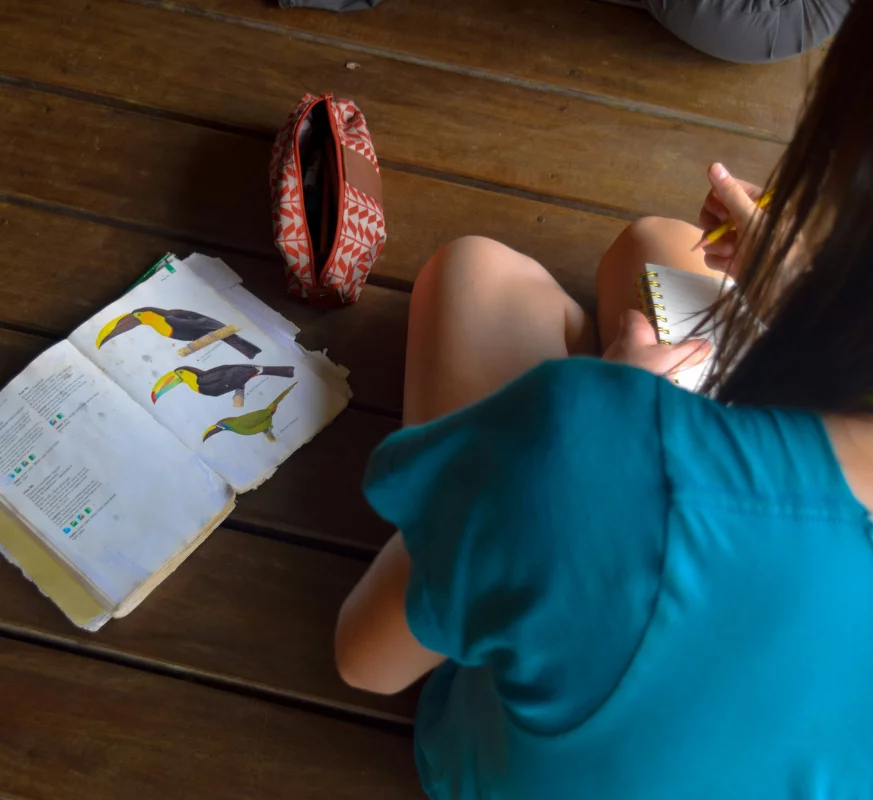
Um, and I welcome the sense of wanting to be a naturalist, um, has come through a lot more strongly. But where I’d say it was lacking is in two or three areas. One is in the keeping of field notebooks and jottings and recordings, actually physically committing down on paper or electronically your thoughts, your observations, your data.
That’s not explicitly put in there as part of a requirement for the [00:07:00] GCSE, and that is so important. There is not a naturalist who has ever lived that hasn’t kept a notebook. And notebooks are not only places to write numbers down, they’re places where you express that connection that we were talking about earlier, which is so important.
They’re places where your interaction, your relationship, personal relationship with what’s before you is recorded, and that psychological process sets in train a whole lifetime of connection. The other thing that’s missing, I think, is a sense of the shifting baseline. And I think until we understand that some of the greatest losses in UK nature has happened within living memory.
In the last 100 years, we have lost 50% of the mass of wildlife in the UK. Until we know that, we won’t make sense of what’s before us now. And that shifting baseline, that sense of [00:08:00] this is normal. You look out of the window and this is what’s normal because this is what you see, as opposed to if you’d looked out of the window 50 years ago, you’d have seen a very different world.
But we just gradually get used to less. We gradually get used to an impoverished world. And so if they could put in some way of tackling the shifting baseline in a way that younger people could talk to the older generation, it could be members of their family or their community. What was it like here 50 years ago?
What was it like here 80 years ago? Tell us what’s gone missing. Tell us what you saw that I don’t see now. Conversely, tell us what we see now that you didn’t see. It’s not all gonna be negative. There’s gonna be positives as well. But getting that recent history back into the naturalist GCSEs, I just think it’s vital.
And we will also then tackle this other phrase, which is the extinction of experience, uh, something Robert Pyle came up with, [00:09:00] which is a wonderful way of saying the less we are outdoors, the less you contact nature physically, viscerally, um, the more that experience goes extinct as the generations go on.
And we have to bring that back. We have to reinvigorate that everyday connection. It all fits together. Shifting baseline, extinction of experience, keeping notebooks, being more attentive, noticing change, all of that comes together. Um, and if that could be strengthened, if we have a very good GCSE.
Ruth Chambers: Thanks, Mary. I’d love to have a poke into your nature notebooks. I’m sure they’re absolutely brilliant, and I love the phrase grounded in localism and inspiring, um, joy and wonder in the everyday environment that you’ve described. We’ve just moved offices, and we’re now in lovely Lambeth in South London.
I was walking down a very busy road, uh, yesterday to the tube station, and a large dragonfly just buzzed in front of me. I was [00:10:00] like, “Where has that come from? Look at the buses. Look at the pollution.” It was really happy, and it was checking me out, so that absolutely made my day. Um, what do you think, Caroline?
What’s good and what’s more to do in relation to this GCSE?
Caroline Lucas: Well, I think, um, the points that Mary have made, I would simply reinforce them. And on that issue of the notebooks, what I love about that is this idea of the importance of paying attention. I think that is just such an important part of life generally. I mean, I think there’s something really kind of philosophically, spiritually, uh, powerful about doing that, and it’s so easy to go through life without paying attention.
And actually, when she was talking, it reminded me that in one of the very early iterations of this GCSE, we did have, um, a proposal that the arts should be part of it as well. Because what the discussion about paying attention reminds me of is the wonderful poetry of Mary Oliver, um, who has inspired me hugely, and she talks about, um, the importance [00:11:00] of paying attention.
She says that, um, paying attention is the start of devotion. And if I’m allowed to give a quick plug to a poem on your podcast, then everyone needs to go away and read “The Summer Day,” uh, by Mary Oliver. There’s that lovely line,
“I don’t know exactly what a prayer is. I do know how to pay attention, how to fall down into the grass, how to kneel down in the grass, how to be idle and blessed, how to stroll through the fields, which is what I have been doing all day.Tell me what else I should have done. Doesn’t everything die at last and too soon? Tell me, what is it, what is it that you plan to do with your one wild and precious life?”
I just think that’s beautiful. And to me, that is connected to this GCSE because it is about what individuals will learn about themselves and learn about the world around us in a much wider sense than simply a GCSE that is on the curriculum, if you like.
So yeah, I think this is something really deep and really important.
Ruth Chambers: I’ll see your Mary Oliver quote and I’ll raise you, and it may even be from the [00:12:00] same poem, but, uh, one of my favorites is where she says, “Let me keep my mind on what matters, which is my work, which is mostly standing still and learning to be astonished.”
Ruth Chambers: Coming to timescales, and we hope that the government isn’t going to be standing still, but hopefully will be astonished by the, uh, the opportunities that this new GCSE will bring.
It normally takes government, as we know, between three and six months to publish their response to consultations. This consultation closes in September, so that would take us to March 2027. As you explained, Mary, we’ve already been 15 years on this journey. What’s your view on when this new GCSE should be ready to launch, Mary?
Mary Colwell: I’m absolutely convinced it should be launched when it’s ready to be launched. And much as after this long and rather torturous journey, it looks like now being a reality, I think it would be a great mistake to rush it through. Um, I [00:13:00] think what we need to do is get everything right. We need to get really good textbooks written.
We need to get really good support materials out to teachers. I would love to see a whole bank, a sort of library of the country’s greatest naturalists giving lessons on whatever turns up in the syllabus. So you’d have Tim Birkhead talking about seabirds. You know, you’d have, uh, really perfectly… the perfect person to teach young people about whatever is in the syllabus.
Now, that’s gonna take time, and that will take time to develop well. The worst thing we can do, I think now, is to rush it through just because it’s popular. I think let’s now take our time, get it right, get schools feeling confident and teachers feeling confident that they’re supported enough to teach it, and then we launch it out onto the world.
But before that, if it’s rushed through, it has the danger of being a little bit [00:14:00] shoddy, a bit insubstantial. It won’t fire the young people’s imaginations about what natural history is. The biggest problem we have is that most people have forgotten what natural history is.
They don’t… They think it’s about climate change and sustainability. We’ve forgotten that it’s about animals and plants, creatures. It’s about the living world around us and knowing that living world intimately, and that takes time to develop those materials because they’ve been lost. They need to be brought back together again and presented in exciting and enticing ways that make natural history such a relevant subject going forward in their lives.
Caroline Lucas: I mean, I agree with that, but I am also concerned about the risks of it falling beyond the next general election. Um, I mean, who knows what will happen at that election, and I can’t help worrying. I mean, we started off talking about the long and winding road that’s led us to this moment, and we thought we’d got this GCSE, you know, several years ago under the Conservatives, and we had a [00:15:00] wonderful launch at the Natural History Museum.
We had the Secretary of State, who was then Nadhim Zahawi, giving a wonderful speech about how the government was committed to this. Uh, and then, of course, they moved very slowly, and then Labour came in, and originally Labour wasn’t at all sure about this qualification. They thought it was a Conservative idea, so we had to go right back to square one and persuade them that it wasn’t.
We were able to build up a good relationship with the Secretary of State, Bridget Phillipson. Who knows what’s going to happen, uh, you know, under a new government, uh, well, a new prime minister, so although I absolutely do agree with what Mary has said, I just also have concerns that if it does fall into the next government period, then I just don’t want to see us going back to square one again.
Ruth Chambers: Absolutely. There’s obviously a bit of a tension there between quality and speed as ever with all kinds of government initiatives. But, um, I think it would be great for this to have made substantial progress by the time the next general election comes, even if it isn’t quite ready to launch.
[00:16:00] Um, Mary, this is for England only, isn’t it? So it’s an England-wide GCSE. The devolved administrations are looking at this. Are they interested in doing something similar, do you know?
Mary Colwell: We’ve had conversations, is how I’d put it. So I think Wales is very keen, uh, and Scotland is keen, but they have a different system than we do. And, um, and so I think it has to now fall to Welsh, Scottish, Irish, Northern Irish campaigners and strategists to work out how it fits into their own particular education system.
But I’ve certainly been approached by Scotland and Wales to say that they are interested in how do they get this off the ground. So yeah, let’s see. Oh, wouldn’t it be wonderful if the whole of the United Kingdom could offer it, and therefore we would be world leaders in this because no one else is doing it.
No, I don’t know any other country that’s offering this kind of qualification. So that’s one of the reasons it’s been so frustrating. As Caroline said, it’s taken [00:17:00] fifteen years to get to this point, you know. And, um, and so fifteen years we’ve had a lot of thought and a lot of experience behind how making this happen, and we are very happy to help make that available to others.
But it really is up to now people within the different nations to fight for it. I don’t think it can be done from here, but yes, wouldn’t it be great to have a UK-wide qualification?
Ruth Chambers: Well, with new parliaments and new governments in Wales and Scotland, there’s an opportunity for the communities there to take that ask directly to them. Northern Ireland elections next year, wouldn’t it be great if this was a manifesto commitment for the parties there? Maybe one to come back to. So, um, just to start to wrap things up, uh, a final question, and we’ve sort of touched a little bit on this, but, you know, it’s clear from the conversation we’ve enjoyed together today that a natural history GCSE would be a really big step forward. [00:18:00]
But what else do you think might be needed to help young people in the challenging yet wonderful world in which we live to develop a sense of awe and wonder about the natural environment that they find, um, around them? Start with you, Caroline.
Caroline Lucas: Well, I think just having more time in that wonderful environment would be a very good start. And, you know, I do worry that the rest of the curriculum as a whole is getting narrower and tighter all the time. And so even though at primary school you have a kind of a sense that many young people do enjoy their forest garden and do enjoy some lessons outside and so forth, as soon as you get to secondary school, then that narrows down.
So I think there are some wider issues about how we weave some of these issues through the rest of the curriculum. But also access more widely. I mean, we know that access to green space in England and Wales is hugely unequally spread, and we know that people from lower income backgrounds, people from ethnic backgrounds and so forth, are far less likely to have access to green space.
Um, and so it feels [00:19:00] to me that we need to do far more to make sure in the development, uh, and planning space that we build in access to green space right from the start. Um, and we do that on a far more equitable basis. And also actually another campaign that I’m very involved in is the Right to Roam campaign, the right of responsible access to nature.
Um, we know that in England, we only have legal access to around eight percent of the land. So I think there’s a lot to do in terms of really being able to underline the idea that it’s our right to be in this natural world. It’s– we don’t have to keep worrying about barbed wire and fences.
I mean, obviously there are places where it’s not appropriate to roam and certain times of the year when it’s not appropriate to roam, and Mary will be the first to talk about ground nesting birds, I’m sure. But all, you know, with that said, and with the protections there when needed, it just feels that that sense of our, of our birthright, our heritage, being in the land and with the land and knowing the land and loving [00:20:00] the land is something that we’ve lost, and I think that’s made our lives poorer as well as the natural world around us.
Mary Colwell: I would love to see, um, I would love to see a greater connection between natural history, as in the studying the subject, and the connection out to all the other parts of life. All the art, the music, the poetry, the literature, the history, the geography, the mathematics. Everything that we do can be traced back to nature, can be traced back to the forms, the sounds, the sights, and the wonder of the natural world.
And the more that nature is put into this much broader context of the human experience of being a living, breathing mammal in this extraordinary planet, the more we can make our relationship with nature, uh, evident everywhere in our drama, in everything that we do, then I think that will just slowly build the awe and wonder, which is what sustains all of life.
Without awe [00:21:00] and wonder, we’re sort of walking shells really, and awe and wonder comes from the cultural world as much as the physical world. So joining those together much more strongly, I think will benefit everything.
Ruth Chambers: Amazing. And do you have an experience of awe and wonder that you’ve had recently that you wouldn’t mind sharing, uh, Mary?
Mary Colwell: Um, actually I was watching a giant bumblebee, you know, the big bumbly little balls of fluff that you get in the garden yesterday. And it was so big and bumbly, and it was feeding amongst all the smaller little bees and solitary wasps on this plant we have, this marjoram that’s flowering.
And it just seems so big, and it just seems so clumsy, and yet it was so at home. And every time it landed on a flower, the flower sort of dropped and it fell off. And it made me laugh, it made me delightful, it made me, uh, just wonder at what brought all this into being. And I think just [00:22:00] watching a bee feeding in a garden is as much a source of joy for me as going to any Serengeti.
You know, there is delight in the smallest and most ordinary of life around us, and a little bit of delight every day just is what we all need, isn’t it?
Ruth Chambers: I think you might have invented a new adjective there, bumbly. Maybe not, maybe it exists. Um, Caroline, do you have a bumbly experience that you wanted to share?
Caroline Lucas: I was going to reflect that most of my days are rather bumbling, but perhaps not in the way that Mary means. Um, I mean, that was a beautiful reflection. I suppose what came first of all to my mind was, um, we’ve moved recently and we’re now near to a place called Cuckmere Haven, which is an area I absolutely love in East Sussex.
And we were lucky enough a few months ago to see a kingfisher and to see it up front and just the brightness of its feathers and its… And we, [00:23:00] we, I don’t know, it may be it just wasn’t aware of us there. We were able to stand for five minutes quite close to it, just transfixed, and just that flash of colour and otherness and strangeness and wildness in a way was just so beautiful, really heart-stopping.
Ruth Chambers: Amazing. It obviously didn’t know who you were, otherwise it would’ve stood to attention on a branch without doubt. Um, many thanks Caroline and Mary for joining our Green Lines podcast. It’s been brilliant to hear your thoughts about not only the natural history GCSE, but our connection with the natural world as well.
So thank you for joining us.
Caroline Lucas: Thank you so much.
Ruth Chambers: If you want to respond to the consultation on the natural history GCSE, you have until the 4th of September. Details of how to respond are on the Department for Education website, and please do look out for more episodes from Green Alliance on your podcast feed. You can subscribe on your favorite podcast app, or you can follow us at Green Alliance on LinkedIn [00:24:00] or Bluesky.
And please do use the hashtag #GreenAlliancePodcast to join in the conversation.

Related content
View AllWhat will Andy Burnham’s government mean for UK environmental policy and politics?
4 August, 2026
What will Andy Burnham’s government mean for UK environmental policy?
29 July, 2026
What’s next? Navigating environmental politics after the May elections
14 May, 2026
How does conflict abroad shape energy, costs and climate choices at home?
1 April, 2026